Tuesday, May 14, 2013

Badakhshon pt. 1: Arriving in Khorog.

Khorog has been sitting on a high pedestal in my mind since I applied to be a Fulbright ETA back in August 2012.

It was first described to me when I was 15 or 16 years old and traveling through Northern Pakistan as a city nestled between some of the worlds highest mountains, which had beautiful dancing, a 99% Ismaili Muslim population, and a strange customary drink called "sheer-choi" that involved milk tea with butter and salt.

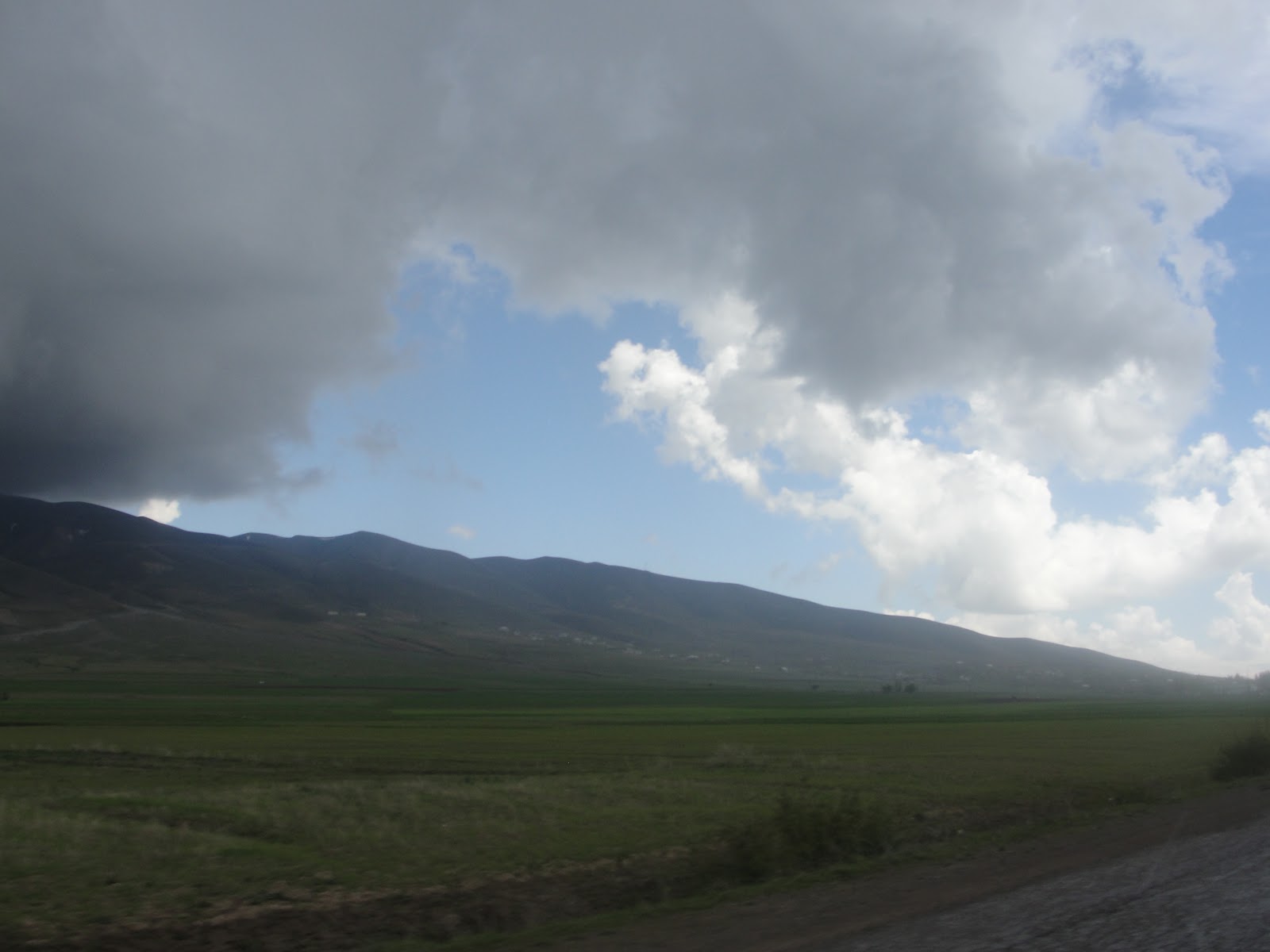
Rain clouds encroaching as we left.
In fact, I knew about Khorog before I knew about Tajikistan.   Originally, I thought I would be spending more time in Khorog during this grant than I actually did.  As I mentioned in a post back in September, political and personal reasons kept me in Dushanbe. However this past week I finally traveled to the eastern, mountainous, semi-autonomous region of Badakhshon, the capital city of which is Khorog.  Given its minority religious background, its unique political and cultural history, the fact that I was traveling with two PhD-experts (one Persian studies and another post-Soviet studies), and finally, given the extremely short time we had to see everything...my mind is exploding with significant things to mention now.

Fill 'er up.
I should start with the route we took.  We set out on a misty Monday morning on a road that takes anywhere from 9 to 25 hours to traverse depending on unpredictable road conditions.  Windows cracked open, the smell of eucalyptus, dawn, and occasional bursts of burned rubber drifted in and out.  We headed east to the first checkpoint outside Kuhistoni Badakshon/GBAO, and turned south to meet the Panj River, which we continued to follow for 8 hours alongside the Afghan border.  The river dividing the countries is a mere 100 meters across in some places.   The path following the river is part of the famed Silk Road...the one I read about in seminars at Brown, which has been celebrated in pan-Asian festivals galore, which has been appropriated by State Dept as a "21st century strategy" of economic resurgence, that same Silk Road Marco Polo took...
We followed the route marked by the red line from Dushanbe to Khorog.  courtesy: caravanistan.com 

Many naps and two pit stops later we rolled into the Pamir Guest Logde around 10:30 PM.  We had been on the road for 15 hours in total.

We checked in, were served an evening tea, and finally nestled into our rooms.  The rooms' stone walls glinted with tinfoil rocks and swirls of course, Badakhson-made cement.  Our beds were kurpachas (large pillowy cushions used as mattresses across Central Asia) raised on platforms.  But it wasn't until morning that we saw the most spectacular bit of the lodge - the view.

And that is pretty much the view from any part of this city.

I got a small town vibe walking around Khorog that I always imagined small-town America would be like.  Khorog looked remarkably clean.  There are only two major thoroughfares in the city and lots of smaller alleys that cut across.  There are a manageable amount of motor-vehicles and pedestrians, cars actually stop at the lights, and folks stopped to greet one another very frequently.

Strolling from the American Corner Khorog to the Aga Khan Lycée (where I met my Asia Youth Forum debaters) I couldn't help but wonder about July 2012 when the capital sent military forces to Khorog in the middle of the night - a startling move that led to gunfights, some riots, and a mass communication closure, which prevented anyone outside of Khorog from contacting those inside and vice versa.   (I blogged about my students recounting this story earlier in the year)

What immediately caused this shocking breach of civilian rights?  Like many such authoritarian interferences, the exact timeline of unfolding actions, perpetrations, and violence is not clear.  Media outlets are still probing into matters more thoroughly.  Here's EurasiaNet's synthesis of misinformation and conflicting stories. However the stories I've heard are mostly from 17-year-olds and they feature feelings of panic and distraught mothers. Whether the government was showing their might and staking their claim in illicit narcotics trade or whether the situation was actually a regular military check-in gone awry in the hands of untrained underage soldiers and armed citizens in Khorog - whatever the story, it actually makes little difference.   Seeing Khorog in person just makes me earnestly hope that tempers and angry memories wont result in another boiling flashpoint.  I feel more like a protective mother in these situations and less of an objective or analytical third party researcher.

A staged, pastoral picture of Badakhshoni
women in a periodical from the 50s
After a successful meeting with the debaters at the Lycée, I walked the short distance to Khorog Museum.  If there is a museum in an unexpected locale - I am there!  My favorite part of zany, rural museums is always their approach to life-like reproductions.  Khorog's museum had no shortage of idiosyncratic presentation methods to allude to "real life back in the day."  There was a pair of handmade paper maché-looking models wearing  traditional Badakhshoni dress, a loom to weave cotton fabrics that took up one-fourth of the traditional tools room.  Of course, there was a random, dusty, but stereotypically mandated taxidermy room.  I lingered in an atrium with local wildflowers pressed in glass frames, while in the next room, my eyes glazed over rows and rows of uniformed cadres remembered on the walls for fighting Bolsheviks in the 1930s.   I can never train my eyes on faces of important or historical personalities in old photos - particularly in military portraits.  But, for me, important faces are much easier to spot in charming family photos, in loungewear, out of unoriginal fatigues.


After making one more stop at the American Corners to assist with a discussion, I met my travel buddies for dinner at the only renowned restaurant in Khorog:  Delhi Darbar.  That's right.  This girl went all the way to the Roof of the World, one of the remotest and least known areas on the planet, and had Lamb Vindaloo her second night.  But honestly the food across Tajikistan is quite similar.  And there was plenty of Osh and Shurbo to be had over the next five days as we set out for the Wakhan Corridor...


Tuesday, April 23, 2013

The time of our lives

If there is one thing I didnt expect to become the highlight of my Fulbright experience in Tajikistan, it would be becoming the coach and adult chaperone of 16 Tajik high schoolers at Asia Youth Debate Forum at Lake Issykul, Kyrgyzstan.  We spent two glorious, sunny weeks in April plunging into the finer details of digital freedom (not once did we plunge into the pristinely blue but freezing cold lake!)


In fact, I remember insisting on my Fulbright application that I wanted to explore Tajik handicrafts and small businesses.  Although I did dabble in some work with jewelry makers and gem polishers, I would say the heart of my 10-month teaching and research experience is debate. 

Looking back over my blog posts, I can trace how debate evolved from a popular teaching exercise into my primary way to sustain conversations and develop critical thinking with all stretches of Tajik youth.  

But without a doubt, the last two weeks have been the pinnacle of success for my debaters and for me personally as a teacher.
Tajik Delegation

I should start off right here by saying the Tajik delegation was wildly successful.  Out of about 160 debaters, a Tajik kid was best speaker, and in the second week of tournament the winning team had 2 Tajiks.  But even without victories (as cliche as it sounds) we won in so many ways....


Win # 1:
http://ayf.idebate.org/news-articles/students-vietnam-and-tajikistan-win-asia-mixed-teams-tournament <<Here are the details of the winning team.  However, the real backstory is that kids from Dushanbe (the capital city) and the Pamirs (Eastern, mountainous semi-autonomous region) were having some troubles getting along...
The two on the far right are from Tajikistan.  That's the girl in the white shirt from Dushanbe and the boy to her left in the white shirt and gray sport coat.  How fly are they.

It wasn't a serious political or deep-seated dislike (historically their respective regions clashed in the civil war, and each belongs to different ethnic/linguistic groups).  But debaters from both cities came with their "cliques" and so they were not getting along at all.  In fact, the Pamiri group aligned with the debaters from Palestine and by day 4 there was some bad talking between the Pamiri coalition and the Dushanbe kids (who found friendship in many Kyrgyz volunteers).  I had no idea how to resolve the adolescent mess and it made me so sad to see the same kinds of problems and tensions from home injecting themselves into the debate prism of respect.  However, by the second week, another trainer and I had sneakily (read: not sneakily at all) gotten kids from both sides onto the same debate teams for the "mixed country track" tournament.  And it was one of these mixed group (which had the strongest speaker from Dushanbe and the Pamirs  and one Vietnamese debater) that won the whole tournament...!  They put predilections aside, because ultimately, victory is sweet.  Im just glad they won together. 

This GIANT statue of a nomadic Kyrgyz
woman/goddess overlooked the Lake.
Inside a replica Kyrgyz yurt

Win # 2:  Some of these kids hadn't flown in a plane before going to Kyrgyzstan.  I think they all got that taste of freedom that everyone needs at that age.  Of course, I felt pretty old being the responsible adult and watching those high school experiences unfold for them.  But there's nothing better than being out and in-charge for the first time no matter where you are from. =)


Win # 3:  It was in Issykul, 8 AM Kyrgyz time, amongst kids and coaches from all over the world including Bangladesh, Pakistan, Myanmar, Laos, Central Asia and others, when I found out about the Boston bombings.  I don't know about you all, but this news hit me hard.  I never usually internalize news, even when I want to; but for some reason the idea of Boston and MIT being attacked was a little too close to home.  I was gripped with homesickness and unwarranted worry, but there was literally no one I could complain to or legitimately grieve with (even very briefly) about the tragedy.  The evening before, I had been talking over dinner to a coach from northern Pakistan about American drone strikes in her town, and I had shaken my head in sympathy when this bright-eyed peace activist and debate coach told me about young boys she saved from entering the fold of Taliban.  So when I got a call from my dad about the bombings, I initially thought I was still in a dream carrying over from the night before.  After watching Russian news for 60 mins hoping for some kind of story (our internet was disconnected) I ended up going late to breakfast before the debate rounds started.  I had to tell the first person I saw about the bombings to keep from looking sad all day.   That person happened to be a Palestinian living in Israel.   That person happened to deal with friends caught in demonstrations and bombings far more frequently than I ever did.   But that person still worried alongside me since she had a friend at MIT in Boston.  I sat down to breakfast hoping when the investigators found a perpetrator, that he or she wouldn't be Arab...   So what's the "win" in this episode?  It's just that I realized every youth and trainer at the Forum cared deeply about their country, but also humanity.  Even the 16-year-olds chowing down before their debate, the loud ones who worried about their clothes and girlfriends and winning the golden trophy, these teenagers were here because some organization (albeit somewhere in London) hoped one day these smart, Asian teenagers will become the voices of moderation and real democracy for the world.  It was a win because I was in a bubble of solution-minded people who agreed to deal with the hypocrisy and tough issues.  I was in a bubble of contented people...although technically we were debating global problems for two weeks...
Kyrgyz, Pakistani, Thai folks & me

A mixed Tajik team debating another mixed Tajik team.
There were so many of us...small country, big presence. 


Now Im faced with the withdrawal and the mixed emotions of being ready to start another chapter but still wanting to be in Tajikistan to encourage debate on a bigger scale.  I have to start thinking about sustainability, the future, and long-term gains for those who were involved.   


As for myself, I don't have specific plans to continue debate in my next location.  Yet if out of the blue I ever got the chance to coach or debate, or work with youth in this capacity again, I know it would be really, really hard to say no.


~AA

Friday, March 22, 2013

Steppin' out

Im back after my blogging hiatus.  It was a consuming month, and I was doing a LOT more of the same.  But the volume of school visits and English trainings and debate trainings and Ismaili Center story tellings have intensified.  I can feel my adult-life bandwidth expanding just a bit. 

But the most pivotal detail of this last week: dark patches of brown spotted alongside of the mountain-crown skyline.   Snow melts and spring rears its feathery face!  We have almond blossoms creeping over fences in yards and more and more flocks of university students strolling the streets later into the evening.

Over the last two months, I've been really missing the all-access pass I had to see performances at the Kennedy Center.  But I am convinced that performance is a part of every society, and I have been hungrily seeking out musical performances in the capital.   I have seen a variety of shows now, but I'll give you a flavor of the few that stand out.  Each are uniquely Tajik.

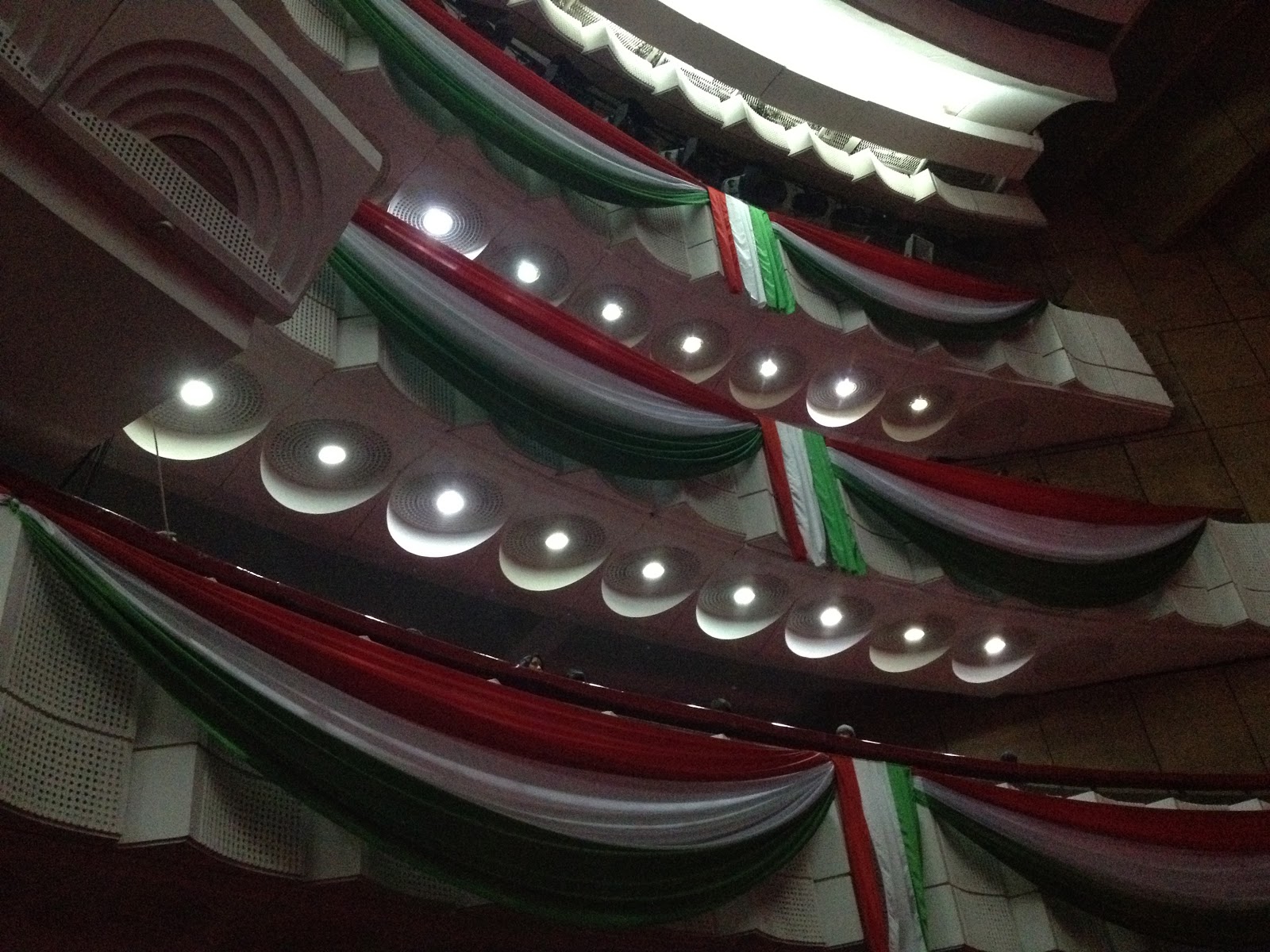
Xohi Borbar Theater looks like a convention center from its exterior architecture, and has a particularly Soviet feel.  The stone, circular building resembles a grounded concrete UFO or the top of a massive submarine.   Like so many Soviet public buildings that were built later on in the USSR, this Theater also strikes me as strange.  Many of the theaters and apartment complexes in Dushanbe have carbon copies in other ex-Soviet states....remnants of the USSR and cool efficiency.  But like a tired schoolteacher on the verge of retiring, the building is now wheezing with overuse.  Nothing was done to maintain its infrastructure, and though these pictures may suggest otherwise, don't be fooled.  The space is not inviting.  Bathrooms are few are far between, the temperature in hall is around 50 degrees Fahrenheit, and there are no vendors...so don't come hungry.   Other concepts the Kennedy Center allowed me to take for granted - ushers, punctual start times, functioning sound systems - are also noticeably absent =p
 This concert, however, was given by Shabnam-e-Suraiyo, who is the Mariah Carey of Tajikistan.  Nay, the Madonna.  Her act was coupled with Tajik rapper Bakha 84.  We waited for 84 whole minutes for the pair to finally ride out on motorcycles.  Although the entire concert was lip-synced, I like to suspend my disbelief in times like these and really just give into the celebrity worshiping that the audience displayed.  Especially the women next to me who came to the concert with a hairdo that was clearly a premeditated trip to the salon.

Here the dynamic duo are performing their joint hit a la motorcycle gang. 
And here's the song...sorry for the glitchy track:  https://www.youtube.com/watch?v=fhrj0R9CdWo 

I'm pretty sure every songs' beat is taken from a more popular western R&B or Hindi film song.  I cant figure out this one though...oh, globalization.

So that's Tajik pop (which no morning mashrutka ride is without).   But we can't talk about Tajik performance without some classic shashmaqon, Tajik instruments, and ladies swirling in National Dress.   I went to a concert put on by the Pakistani Embassy, but which featured Padida Dance Theater, the most prominent dance group performing classical and contemporary.  As a testament to how small and internconnected this country is, the lead dancer of the company also does the choreo for Shabnam-e-Suraiyo.

Dancing is a fairly deeply rooted part of Tajik cultures.  I've found it takes almost nothing to convince a group of people to start dancing if there is a happy occasion to celebrated.  Luckily, dancing is the language I learned way before any others ;)


And lastly, and most recently, I was offered tickets to watch the ballet in Dushanbe.

The Nutcracker.  I've seen this ballet in Houston, New York, DC, and now Dushanbe.


Picture taking was shameless throughout the production.  

No trip to the theater is complete without tantalizing food...Georgian Walnut-stuffed Eggplant rolls.  With some Tajik pomegranates sprinkled on top. 

It's the good life. 

Wednesday, February 13, 2013

The Unexamined Life


Lately the little voice in the back of the traveler’s head that continuously nags the traveler to document has been getting louder.

I am guilty of not reflecting even though I know documenting now is the only way I will make sense of this experience (to myself and others) later.  It's just that I don’t feel those erratic shifts of time and place that usually prompt a crisis, a lesson, a rip in my personal space-time continuum... 

The quotidian incidents in Dushanbe still make the city peaceable and onerous.  These are occurrences such as a quiet, but stern-faced waitress insisting we finish the food we ordered before we leave the restaurant; a trio of bumbling, underpaid policemen creating trouble for a noncompliant taxi driver over a three somoni bribe (roughly 70 cents); or a small pack of Tajik teenagers, blasting Justin Beiber, exchanging a laugh over the foreigner with a giant backpack taking up as much space as the four of them on the street.

But as I examine these moments now, they all seem like facets of real life.   It isn’t strange to be called out for taking up space.  It isn’t impolite to ask that we finish the food we ordered.  I don’t even miss the regular shopping trips I could take if I were in a more commercially open country.  Instead, I like that I spend a lot of my time talking to friends and colleagues about absurdly regular things.  Work deadlines, movies, love lives (who’s getting married and who isn’t), news headlines, food issues, weekends, men, lack thereof…and none of it seems terribly out of place.

There are moments when taking a mashrutka to work, smothered to the right of a gold-toothed 25 year old who is carrying a 6 month old under her striped Chinese shawl, and to the left of two adolescent schoolboys in black and white pressed uniforms, sitting nearly one atop the other and paying the fare for one rider, that moment is more normal than jumping onto any sort of rigorously scheduled subway from Pentagon City or GPS-located bus down Newburry Street. 

I smile knowing that in maybe half a year, I will be walking through a glazed mall in Sugar Land, Texas, eyeing aisles and aisles of shoes and overpriced jewelry, and thinking, “where am I?”
Five months ago, everything was “charming” or “remarkably post Soviet” or “undeniably Persian” or the “mark of crumbling infrastructure” or “the outcome of recent civil war.”  

But, for better or for worse, I have let my background (American Fulbright Teacher from Texas/Rhode Island) and foreground (foreign teaching assistant, aspiring communications professional in Tajikistan?) blur together.  Maybe it’s out of a desire to not feel out of place anymore that I have let the focus lens soften.

Granted, there is still a constant flow of projects: a new hybrid contemporary Tajik jewelry line that I want to help produce and retail, a new grant proposal to sponsor national debate tournaments, discussion clubs, welcome dinners for new arrivals, Tajik classes, laundry Sundays, Jamatkhana Fridays, recipes, gossip.  And though I should, I can’t stop to examine what seems unusual or novel, because it’s much more interesting to just be living it…

Thursday, January 3, 2013

Ongoing debate


I always considered speech and debate noble pursuits.  Speech skills pervade every aspect of life from confidence building to critical thinking skills, and being a good speaker necessitates having empathy and worldliness.  

When I found out there was an international debate community here around 7 years ago, I was pretty interested in what possibilities exist now.  It turns out that 5 years ago, the money for international debate leagues ran out, and all English language debate clubs and schools and universities suffered.  I heard from older debaters that at its height, the debate movement was a way to shake off the hopelessness after the civil war.  But if money and organizers were the only obstacles, and actual interest existed for debate teams, then my existence as a Fulbright ETA in Dushanbe was a blaring solution. 


Indeed, using some Embassy resources, I organized a small but proper debate tournament at the Ismaili Center for my students from American Corner who showed superior language skills and students at a local university.  From the Corner, I hand picked six of the most committed kids who had the best English to form a team.  We practiced debate every day, and they were so eager to prepare that came to each class with research.   I admired their tenacity, and they pushed me to be a better teacher, coach, and resource. 

We were set to debate against a slightly more experienced team from University of Central Asia.  The students had a week with the topics to prepare.  The day of the tournament arrived and we had two teams of three competing.  The first round's resolution:  "This House believes the Internet does more harm than good to children."  Internet accessibility is particularly significant in our context since the Tajik Communications Ministry has been dangerously flirtating with censorship since July 2012.  Many times we wake up to find Facebook, Twitter, and a hundred of other Russian/Tajik news sites blocks for a few weeks at a time.  One of my teams lost, but the other one hailed victorious

The surviving team also made it through the semis where they debated the resolution, "This House would support International Adoption."  Smiling, they went into final round, but this time they did not have the topics in advance.  It was revealed to them 15 mins before the round. The topic turned out to be specific to Tajikistan's cultural history: "This House would ban New Years on December 31st in favor of Navruz (Persian New Year)." This debate was essentially about the cultural legacy of the Soviet Union and Tajikistan's struggle to re-identify itself with its Persian civilizational roots, without become Islamicized or radicalized. 

American Corners had to defend the ban, and lost the round.  In the end, we came in second out of six teams.  Regardless, I was thrilled.  That morning, the other organizers and I feared we were in for 4 hours of stumbling speeches and loopy arguments. But after the final round ended around 5 PM, even the head judge (a local Fulbright Scholar who founded the only gallery place in Dushanbe, Art Ground, and has debated abroad for 7 years) said the level of debate at the tournament surprised him.  The resulting speeches were coherent, the research well grounded, the exposition quite colorful, and the final victory hard earned.  

After the tournament I took my six debaters out to eat some kurutob with Alfred, who was visiting for the weekend from Kulob.  By the end of the meal, my conversation with Begin, Khairina, and Kamila (my formidable muskateers and star high school debaters) turned to the topic of the summertime military invasion of semi-autonomous Khorog.  Khorog is home to many of the leaders of the opposition from the civil war, which ended in 1997.

Although they were born and raised in Dushanbe, two of the girls' families are Pamiri, and so they were in Khorog visiting extended family when the Tajik military invaded the semi-autonomous region.  They recounted to me the events of July 24, 2012.  Since their grandmothers and aunts lived close to the main square in Khorog, their homes were amongst those that the young soldiers invaded first, firing incessant shots without clear direction or training.  Begim told me the attack started at 3:30 in the morning, and her younger brother and grandmother had to hide on the floor of the bedroom until the military forces slowly thinned out. 

After that frightful night, the resulting public outrage and confusion in Khorog resembled military interventions and conflict zones I read about in the papers.  The girls recounted feeling peace was fickle and fleeting.  They described the noise and the smell of charred metal.  They described sitting at home, eyes shut, in panic.  At age 16, they had understood how quickly their country may lapse if not tightly controlled.    

Now as I watch world news,  I see that the same uneasiness is becoming a ubiquitous feeling around the world.  Despite the region or country in which conflict occurs, whenever I read about a military invasion, I can see the same smoke, I can smell the same burnt metal, I can hear the same wails that the girls described.  

Deep down I am nauseously aware that such an experience is not far from any one individual, no matter where he or she lives – Palestine, Russia, California, or Tajikistan.  My young, innocent, bright-eyed debate girls continued sharing the alarming transpirations from the summer invasion. Kamila, who was still in Dushanbe, vividly described sitting at home, pale in the face, waiting for her best friends to call her from the Pamirs while she knew the government had cut off access to the entire region for days without explanation. Of course, Tajikistan is a small country, and there are not many degrees of separation when it comes to internal violence.  But that summer, a dark, black hole had appeared where her best friends’ calls, texts and faces used to be.  It seemed to me deeply unfair. Her story was just one from hundreds.  

I suppose that is why they come to each class of mine with such eagerness.  I don't always understand why I am treated with such gratitude, such respect, and tolerance.  My students, in general, regard any time they spend in my class as a rare gift.  It can be overwhelming and humbling.  But without the student's unbridled support, I wouldn't always have the patience and courage to keep trying new ideas, proposing schemes or events for students to learn English.  

Strangely, as I write this, I remember these are the highfalutin ideals of the Fulbright Program - to bridge barriers through honest dialogue and people-to-people communication.   I know it doesn't seem like I can do that every single day.  But I can see through moments like after a successful debate victory and honest conversations over kurutob, how I've started to come closer to understanding life in Tajikistan. 


Saturday, November 24, 2012

The ex-pat waxes poetic


In the last month I spent a good deal of time celebrating Halloween.  I celebrated it in Khujand, in QurganTeppa, and of course, in Dushanbe.  I indulged in every Halloween habit I could successfully imitate.  Tajik students ate up the games…particularly donut on a string.  Javid and I choreographed a fantastically amateur salsa piece to a gruesome cover of Sweet Dreams by Marilyn Manson.   I went to the freakiest costume party of my life at a club called Snap.  There, I saw a little Tajik girl dressed up in a pregnancy suit with the fetus ripping out of her stomach while listening to a Tajik hard rock/metal band.  Gulp.

I also get a roundabout look into the culture of the armed service.  And here is the point at which my steel ex-patriot coat starts to chip and erode.  I believe Henry James wrote a novel called The American with a very sympathetic lens toward the foreigner in a foreign land.  I’ll have to start that book soon and maybe better undersand my fellow Americans… 

A very sweet Marine gave me a ticket to the US Marine Ball.   I have never had such a candid look into military culture.  Most of the Marines in Tajikistan are early in their career and have never been exposed to another culture.  They live in a very cushy dormitory style complex, they have a personal chef, and 90 different games for PlayStation.  They stay truly American, and spend unbelievable amounts of time together.  At the Ball, they participated in the ceremonial cutting of the Marine’s birthday cake dressed in their “blues” or heavily embellished felt uniforms.  We watched a video heralding the merits of Marines and listened to a sentimental 70 year old marine who vouched the Marines were the toughest and bravest of all the American servicemen and women.  In fact, nothing about the ceremony, the rhetoric, or the ceremony surprised me.  It was exactly what I imagined the armed service was like – protected and a little cultish, lots of booze and back patting.  But I let myself take part and acted like a good date.  I took pictures and laughed at Marine jokes.  I crossed my ankles and lied that I completely understood the United States mission to Tajikistan.  It was interesting to find out why each of these men decided to join the Marine Corps.  I can’t say I agree with their life decisions or with using arms and threatening warfare, but even the Marines acted because they really believe in their country and out of passion. 

One thing that I have learned is to stay out of the ex-patriot cult of partyism.  There are a many things that I could be remembered as, but “the craziest partier” should not one of them.  There is enough alcohol and isolation in this country to  easily find people who are running from something.  What I mean to say is although there are many fulfilled and happy expats working here, there are also those who are cunning and deprived of attention.  This means any party can devolve into a sticky college nightmare if you are not sure of your friends and your exit plan.  I will be slowly ducking out of such expat engagements for the foreseeable future.  

Monday, October 22, 2012

Pop, whiz, bang.


Here we are.  Two months into my time in Tajikistan.  One-fifth of the way through.
Since my last post on my birthday, approximately one month ago, I have done a good amount of traveling around the northern region of Tajikistan, I have added Debate to the classes offered at the American Corner, I have become a consistent attendee of the Aga Khan Humanities Project’s fall Intro to Humanities course as a volunteer teaching assistant, I have moved even further than I already was into my host families hearts ;) and my mother has visited Dushanbe for ten days from America, on a whim.  I would describe the last month as a tornado in a valley, spinning pointedly around me.  I know there is much more I could do, but I already feel swept up in activities every day, minute, hour.  Most of them are small social obligations that I am struggling to fulfill – like a dinner with a new friend, a brainstorming tea time with a coworker, finding the right house-ware for my host mother’s apartment, negotiating shortest way home from a new building, or a day trip with my mom. 

In between these units of community building, I desperately try to maintain a semblance of preparation and lesson planning.  Usually I run with the first idea that comes to my mind for the four Beginner and Advanced classes I run.   I also try my best to attend services at Jamatkhane and make it to regular workouts. 

My favorite part of the city, just as it was the first week I arrived, is running into familiar faces.  In fact now, I constantly wish under my breath that the various units of activity that build up my day will all be scooted aside by an unexpected visitor.  

My biggest setback amidst all of this movement is that the Tajik language buzzes right by me.  I have not soaked it Tajik the way I soaked up Arabic when studying in college.  Arabic was like a hot lemon olive oil that brightened me up.  Tajik sits on my skin like cold grease.   That’s not to say I do not enjoy listening to it or studying it.  Even the coarsely ground specks of Tajik-Russian that the minibus drivers spit at me has a rugged charm.  (Perhaps because I cannot catch all that they are saying to the ignorant, Asian-looking, privileged little American devoshka).  But I do not have the time to steep in Tajik language the same way I did in Arabic-speaking countries The responsibility of constantly teaching English was not an issue while in Syria and Jordan, so I had plenty of time to learn.  It will take a renewed commitment on my part (a commitment I renew each morning) to learn Tajik as fast as I know I can.  Or as fast as I should, since after all, it is one of the most grammatically simple languages I could ask for.

Arabic has an interesting presence here.  A few young men I have met here have started learning Arabic very seriously in order to better understand Islam and the Qu’ran.  My host mother’s brother, who was present at the Eid celebration last weekend, gave me a fifteen minute talk on the merits of praying five times a day in Arabic.  We talked about dhikr, or meditation, in Arabic, and he quoted parts of the Quran that mentioned forms of prayer.  We didn’t come to any agreement on the essence of organized prayer in Islam, but at least it gave me a chance to practice Arabic.  My Arabic is being slowly sacrificed for Tajik (bad Eid-e-Khurbon pun intended).  I was replacing Arabic prepositions and conjunctions with Tajik ones all willy nilly.   Its funny how much faster the mouth is at forming words than the brain…

Meanwhile, other departments of Tajik living, like the weather, are kind of blissful.  I know everybody dreads the winter, and the snow, and the lack of street salt, and lack of sidewalk demarcations, and lack of minibuses, and presence of grey muck, and insufficient indoor heating.  Despite ALL of that, the fall is perfectly orange and yellow. The pumpkins.  Oh, the pumpkins.  And I’ve never experienced so many perfectly crisp light sweater days in a row.  And it’s having a narcotic effect on my mood to where everything seems light and easy.